

A stripped drain plug can turn a $40 oil change into a $200 repair call before the vehicle even leaves the bay. If you are performing gravity drain oil changes, you are actively creating risk with every service.
Fluid evacuators eliminate this risk entirely. Instead of touching a drain plug, technicians insert a probe through the dipstick tube and vacuum the oil out from the top. No skid plate removal. No rounded-off plugs. No contaminated drain pans on the floor.
But the real decision most shops face is not whether to evacuate, it’s which type of fluid evacuation system fits their operation. Portable or centralized? This guide breaks down both options, compares them, and gives you a clear path to the right choice for your shop size, workflow, and budget.
What Is a Fluid Evacuation System and Why It Matters
A fluid evacuation system uses vacuum pressure (pneumatic or manual) to extract used motor oil, transmission fluid, brake fluid, and other non-flammable fluids directly from a vehicle without touching the drain plug.
The difference between evacuation and conventional draining is not just convenience; it is a fundamentally cleaner and safer process. While the most conducive to gravity, draining oil the traditional way leaves residual fluid in pans and hoses, requires removing undercarriage protection on newer vehicles, and exposes technicians to hot oil splash.
Evacuation systems pull fluid upward through the dipstick tube or designated access point, containing everything inside a sealed tank until it is ready to discharge to your waste oil storage tank.
Key stat: According to shop efficiency data, topside oil changes using evacuation can reduce average service time by up to 50% compared to traditional undercarriage drain methods.
Types of Fluids You Can Evacuate
- Engine oil (most common application)
- Transmission fluid
- Power steering fluid
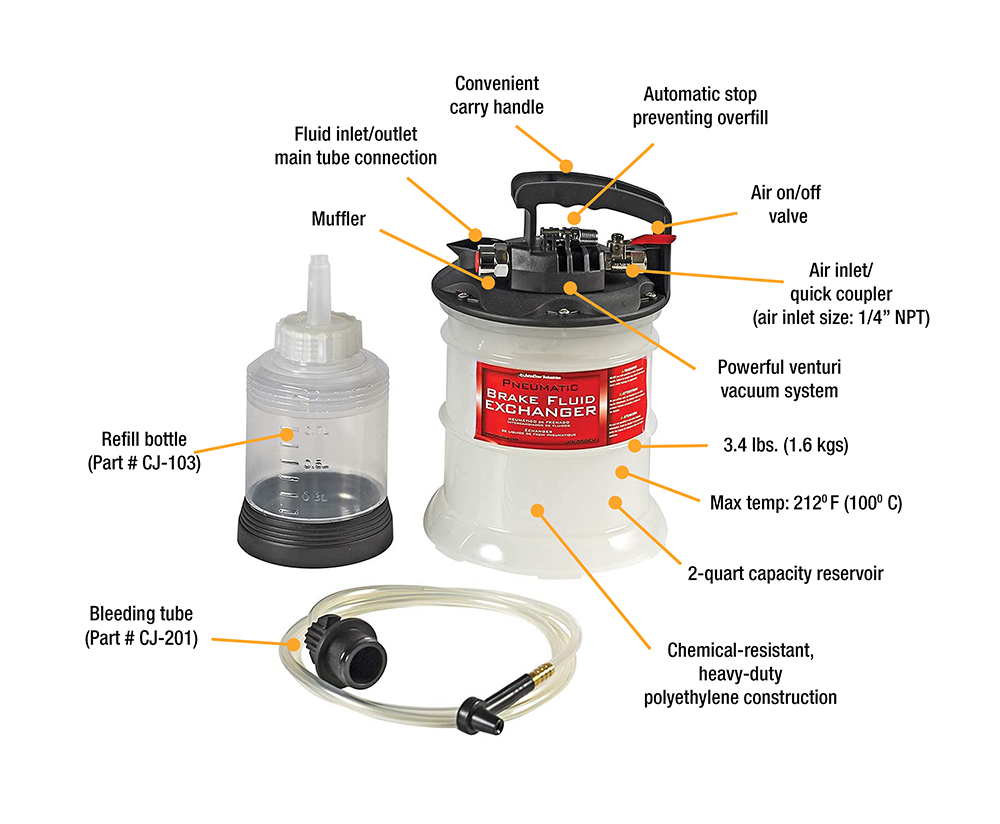
- Brake fluid – JohnDow’s dedicated 2-Quart Brake Fluid Exchanger handles this specifically
- Antifreeze and coolant
- Differential fluid on applicable vehicles
WARNING: DO NOT use fluid evacuation systems on flammable fluids like gasoline. Always verify your fluid before evacuating.
Portable Fluid Evacuators:
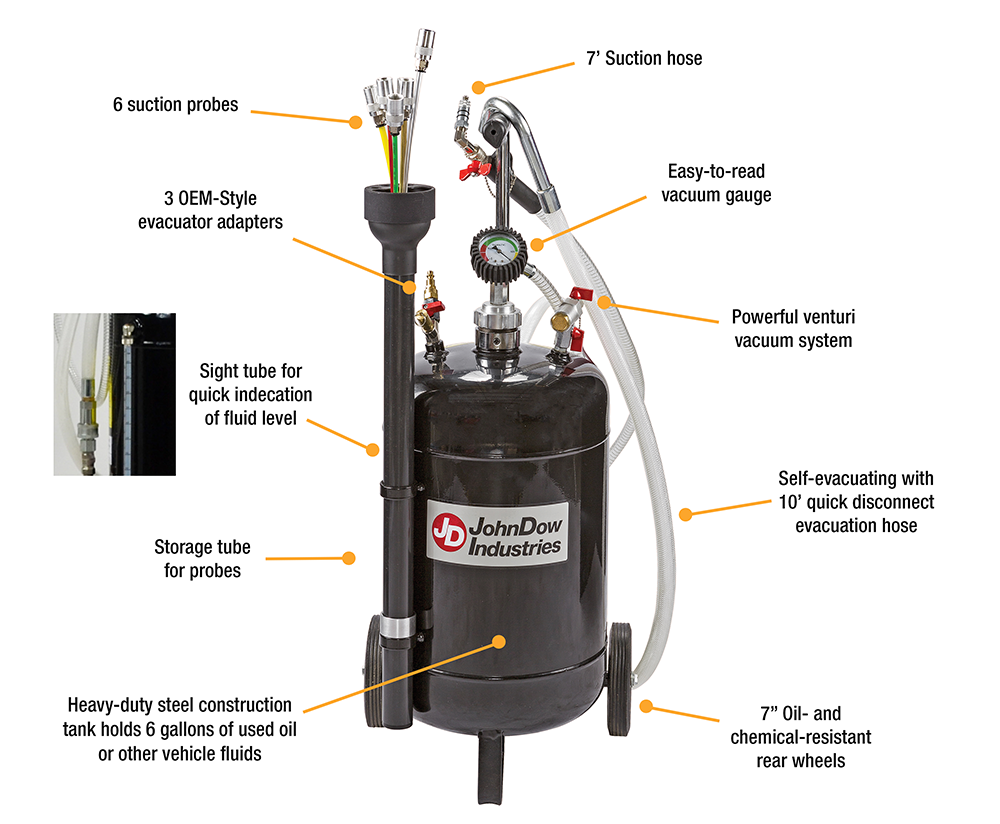
Larger, portable fluid evacuators are wheeled self-contained units you can move to each vehicle and perform fluid evacuation (You will need to discharge to your waste oil tank when full). They are powered by shop air compressors (pneumatic) or manual pump, with no permanent installation required.
The defining advantage of a portable evacuator is it can move to where the job is, not the other way around.
JohnDow Portable Evacuator Options
JohnDow Industries offers a range of portable evacuators, scaled to different shop volumes:
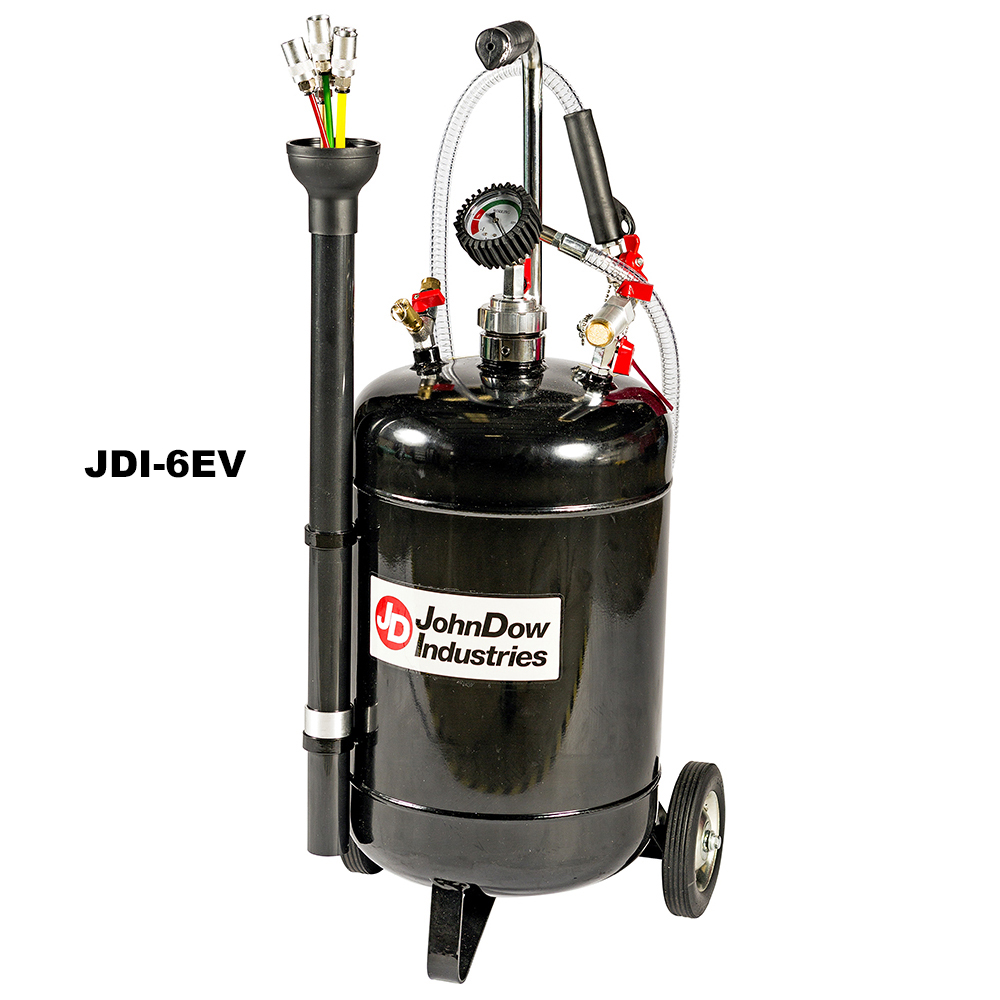
- 6-Gallon Fluid Evacuator – compact, ideal for smaller shops or mobile service units
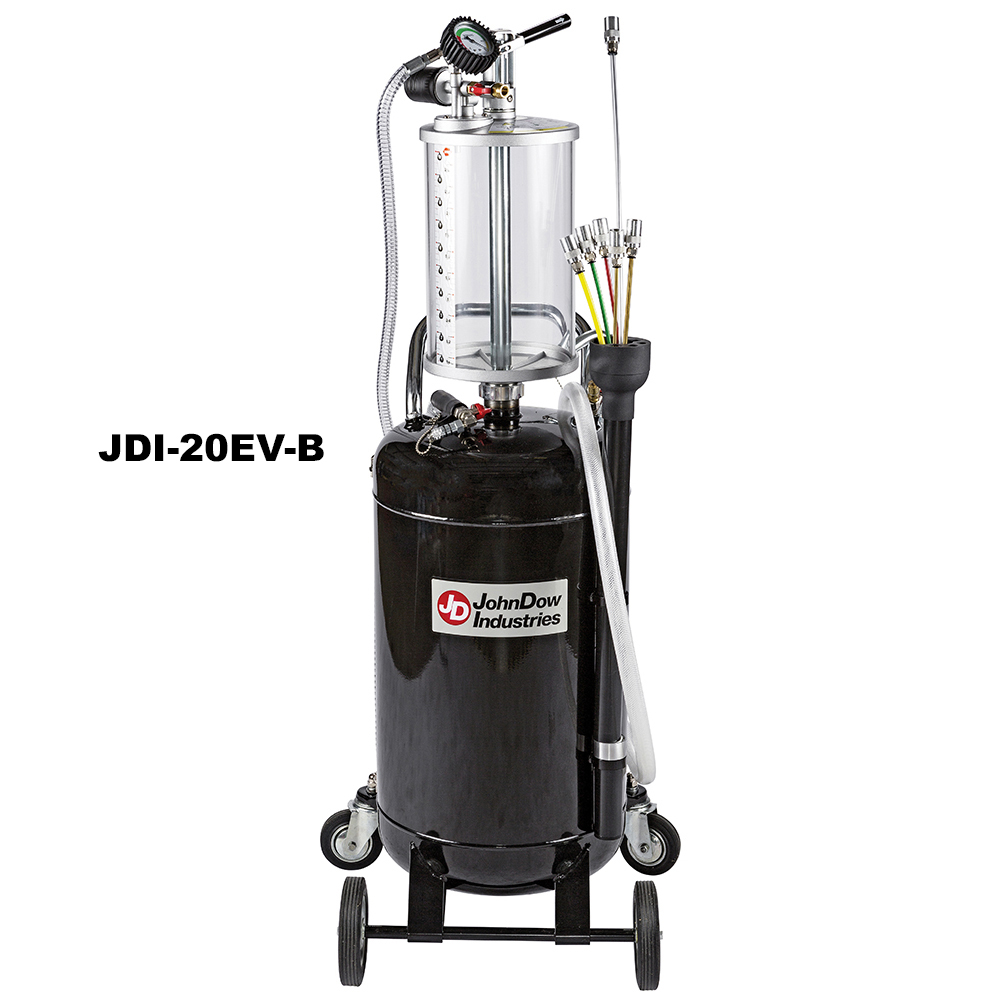
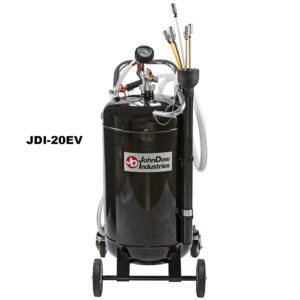
- 20-Gallon Fluid Evacuator (JDI-20EV) – the workhorse unit for most multi-bay shops, with 14-gallon effective suction capacity, a venturi vacuum system running at 110–115 psi, and a 7-foot suction hose
- 20-Gallon Fluid Evacuator with Transparent Bowl – same power with a transparent bowl for real-time fluid monitoring
- 20-Gallon Combination Fluid Evacuator & Oil Drain – all-in-one unit for shops who handle both topside and underside draining
- 1.7-Gallon Manual Vacuum Fluid Extractor – no air compressor needed; great for mobile mechanics or low-volume bays who need to evacuate a lower volume of fluids
- 2.7-Gallon Pneumatic Vacuum Fluid Extractor – fast air-powered extraction in a compact frame
- 1.6-Gallon Manual Extractor & Discharge Pump – 2-in-1 Manual Extractor and Discharge Pump is versatile enough to remove a variety of fluids from all types of vehicles
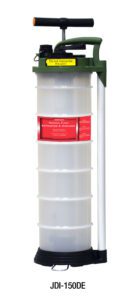
Where Portable Units Excel
- Smaller shops (1–3 bays): Moving one unit between bays is fast and cost-effective when bay count is low.
- Rented or leased spaces: No permanent installation means no capital investment in a building you do not own.
- Mixed service workflows: If you handle specialty vehicles alongside standard oil changes, a portable unit adapts to different probe configurations.
- Mobile service vans: Compact extractors like the manual 1.7-gallon unit work in field service without shop air.
Where Portable Units Fall Short
- In a 6-bay shop doing 80+ oil changes per day, rolling and repositioning one unit becomes a measurable time tax: typically 2–4 minutes per vehicle in wasted movement.
- Portable tanks require regular discharge cycles. A 20-gallon tank holds roughly 14 gallons of effective capacity, which fills quickly on busy days.
- Hoses and probes on portable units are handled more frequently, meaning more wear points over time.
Centralized Fluid Evacuation Systems:
A centralized fluid evacuation system is a permanently installed system in your shop. Dedicated evacuation lines run directly to a waste oil storage tank, with a connection point at each service bay. There is no rolling unit, no repositioning, and no mid-day discharge interruptions.
JohnDow’s Centralized Fluid Evacuation System is revolutionary to the industry as no other similar system is available in the market today.
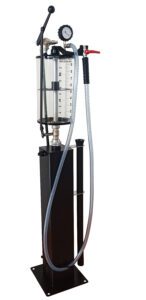
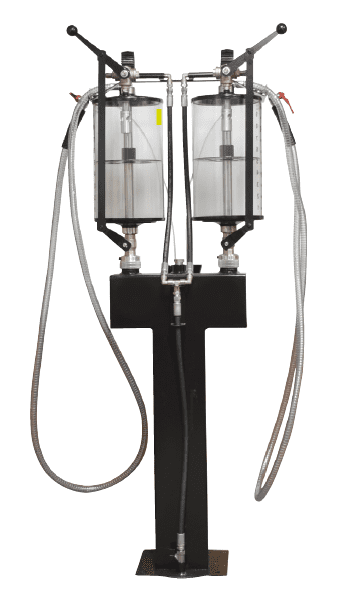
“Simplicity was at the heart of our design. We engineered every detail to make the evacuation process intuitive and effortless for technicians.” – Jack Blackburn, VP of Manufacturing & Engineering, JohnDow Industries
How It Works
A professional installer permanently installs the system into your shop’s infrastructure. Each bay has a dedicated evacuation station; technicians walk up, connect the probe, and begin the evacuation process. Used oil travels through fixed lines directly to your waste oil collection tank. No intermediate tank to empty, no unit to wheel around.
JohnDow engineered the centralized system to eliminate the need for a compressor, which is a significant operational simplification compared to pneumatic portable units needing shop air.
Who Should Choose Centralized
- High-volume quick-lube operations: If your car count goal is 20–40+ vehicles per day, the labor time saved per vehicle compounds into significant weekly revenue.
- Multi-bay service lanes: Standardizing the process across every bay saves time and eliminates inconsistency in how technicians perform oil changes.
- Shops with pit configurations: JohnDow specifically notes the centralized system is for shops with service pits for best design integration.
- New facility builds: If you are designing a shop from scratch, routing evacuation lines during construction costs a fraction of retrofitting later.
- Operations focused on customer experience: Cleaner bays, faster turnarounds, and more organized workflows directly translate to customer perception.
The Installation Reality
The centralized system requires professional installation and works in both new and existing buildings. JohnDow’s team can guide configuration to match your bay layout. The upfront investment is higher than a portable unit, but for any shop doing consistent volume, the per-vehicle labor cost reduction pays back that gap faster than most owners expect.
Head-to-Head Comparison: Portable vs Centralized
|
Factor |
Portable Evacuators |
Centralized System |
|---|---|---|
|
Upfront cost |
Lower – no installation needed |
Higher – permanent setup |
|
Setup time |
Plug-in, ready in minutes |
Professional install required |
|
Flexibility |
Move between bays freely |
Fixed at each dedicated bay |
|
Oil change speed |
Faster than gravity draining |
Faster than gravity draining |
|
Floor space |
Requires storage & movement path |
No rolling equipment – cleaner shop |
|
Best for |
1–3 bay shops, rented spaces, lower car count |
4+ bay shops, high-volume operations, higher car count |
|
Skid plates |
Eliminates need to remove them |
Eliminates need to remove them |
|
Long-term cost |
Moderate (consumables, empties) |
Lower cost per vehicle over time |
How to Choose: A 4-Question Decision Framework
There is no universally correct answer since the right system depends on your specific operation. Ask yourself these four questions:
1. How many bays do you operate?
For 1–3 bays with oil changes not being a main focus of your business, a high-quality portable evacuator like the JDI-20EV gives you professional-grade performance without installation complexity. Four or more active bays, and the cumulative time cost of moving a portable unit starts to outweigh the savings and centralized becomes the smarter investment.
2. Do you own or lease your space?
If you are leasing, a permanent installation requires landlord coordination and may not survive a move. Portable systems protect your capital investment regardless of where you operate.
3. What is your daily vehicle volume?
Fewer than 20 vehicles per day: a well-maintained portable unit handles this without constraint. Above 30 vehicles per day across multiple bays: every minute saved per vehicle is worth roughly 30+ minutes per day in recaptured labor, which adds up to hours each week.
4. Is this a new build or a retrofit?
New builds for higher-volume oil change shops should seriously evaluate centralized as a default. Routing lines during construction costs far less than cutting into existing floors and walls later. For existing shops, JohnDow’s system is designed to work in both scenarios, but contact JohnDow before assuming costs.
Common Mistakes to Avoid
Buying by tank size alone. A 20-gallon portable unit has a 14-gallon effective suction capacity. Always check the actual suction volume, not just total tank size, to plan your discharge frequency.
Ignoring probe compatibility. Not all probes reach the bottom of every oil pan. JohnDow’s portable evacuators include six suction probes and three OE-style adapters so verify fitment for specialty vehicles like European imports, trucks with deep pans, or newer models with restricted dipstick access.
Underestimating installation scope for centralized systems. Getting a professional layout consultation before committing to a centralized build is not optional. It requires line routing, tank placement, and bay-to-bay consistency.
Assuming topside evacuation works on every vehicle. Most passenger vehicles and light trucks are fully compatible with topside evacuation. A small number of vehicles have dipstick tube configurations that limit probe insertion depth. Consult vehicle-specific fitment guides and use the appropriate adapter.
The Bottom Line: Match the System to Your Shop
The decision between a portable and centralized fluid evacuation system is not about which is better in the abstract. It is about which one fits your shop today, and where you are heading.
If you are running a small or growing shop, starting with a high-quality portable evacuator makes complete sense. The JDI-20EV 20-Gallon Fluid Evacuator handles everything a 1–3 bay operation needs and costs a fraction of a permanent installation. When you are ready to scale or if you are already running a high-volume multi-bay facility, JohnDow’s Centralized Fluid Evacuation System removes every friction point from the process and cuts your average oil change time in half.
Ready to see which system fits your shop? Browse JohnDow’s full Fluid Evacuator lineup or call 1-866-382-5057 to speak with an equipment specialist.
FAQ
- Do fluid evacuators actually remove all the oil from an engine?
Topside evacuation removes approximately 90–95% of usable oil from the pan – operationally equivalent to a full drain for standard service intervals. - How long does it take to install a centralized fluid evacuation system?
Installation time varies by shop size and build type. New construction is faster and less costly than retrofits. Contact JohnDow’s team for a layout consultation and timeline estimate. - Can I evacuate all types of vehicle fluids with a portable unit?
Most non-flammable automotive fluids can be evacuated – engine oil, transmission fluid, power steering fluid, coolant, and differentials. Brake fluid requires a dedicated exchanger like the JDI-050EV Brake Fluid Exchanger. Never use standard evacuators with gasoline or flammable solvents. - What air pressure do JohnDow pneumatic evacuators require?
The JDI-20EV requires 110–115 psi to operate the venturi vacuum system. Most standard shop air compressors operate in this range. If you are running a smaller portable compressor, verify your working pressure before purchasing a pneumatic model – or consider the manual vacuum extractor as an alternative that requires no air supply. - Can I use a portable fluid evacuator in a leased shop space?
Yes — portable evacuators require no permanent installation, making them the practical choice for leased or rented spaces. There is no plumbing to run, no floors to cut, and no landlord coordination required. If you relocate, the equipment moves with you.