

The Short Version – TL; DR
Both manual and pneumatic fluid extractors pull fluid with a probe through the dipstick tube or filler port. Manual extractors run on hand-pump power, which is why DIYers love them for home use. Pneumatic extractors connect to shop air, which is the right call for professional service bays handling multiple fluid changes a day. This is not a quality comparison – it is a workspace and workflow comparison.
The first time most people realize there are two fundamentally different types of fluid extractors, they assume the pneumatic version is just “the better one.” Nope, not true.
A DIY mechanic who buys a pneumatic extractor for their home garage (only to find it cannot work without a shop air compressor) may have wasted money on a toolhe/she cannot use. And a shop owner who buys manual extractors will watch their technicians spend unnecessary time pumping handles between every job.
The right manual vs pneumatic fluid extractor comparison starts with one question: where are you working, and how often?
This guide maps each type to the right situation, covers the JohnDow models built for each, and gives you a clear, direct answer before the end.
How a Fluid Extractor Actually Works
A fluid extractor – also called a fluid evacuator or vacuum extractor – removes engine oil, automatic transmission fluid (ATF), coolant, brake fluid, and gear oil from a vehicle without dropping a drain plug. A probe feeds down through the dipstick tube or filler port into the reservoir below. A vacuum pulls the fluid up through the probe and into a sealed collection tank.
The vacuum is what every extractor has in common – the power source is what separates the two types.
Both manual and pneumatic models use the same probe-and-tube design based on the venturi effect – a principle of fluid dynamics where airflow through a constricted passage creates a pressure drop that generates suction. Both work with the same range of automotive fluids. The difference is entirely in how the vacuum is generated, and that single difference determines speed, portability, and which environment each type belongs in.
Manual Fluid Extractors: Built for the DIY Mechanic
A manual extractor creates vacuum through hand-pump action. You stroke the handle – typically 10 to 20 pumps – to build suction inside the collection reservoir. The vacuum then draws fluid continuously through the probe until the tank is full or you close the valve.
The defining advantage of a manual extractor is that it works anywhere, at any time, without a single piece of additional equipment.
No compressor. No air line. No infrastructure investment. For a DIY mechanic, that independence is not a minor convenience – it is the whole point. You can use a manual extractor in your driveway, a storage unit, a campsite, or anywhere else you maintain your vehicles.
Consider a scenario where a home mechanic handles their own oil changes three or four times a year – their daily driver, a motorcycle, and a riding lawnmower. They have no air compressor. A manual extractor handles all three platforms without requiring several hundred dollars of compressor hardware before they can even start. That is exactly the use case these tools exist for.
JohnDow makes two manual extractors built around that DIY reality:
The JDI-172EV 1.7-Gallon Vacuum Fluid Extractor is the straightforward workhorse for home garage fluid service. It holds 1.7 gallons (6.5 liters), handles temperatures up to 212 degrees F, and weighs 6.6 lbs. It ships with three extraction probes – two dipstick tubes (0.23″ and 0.26″ outer diameter, or OD) and one main extraction tube (0.39″ OD) – covering the full range of filler ports and dipstick tube sizes found on cars, trucks, motorcycles, ATVs, and small equipment. A sliding foot pedal stabilizes the unit during pumping, and an automatic stop prevents overfill.
The JDI-150DE 1.6-Gallon Manual Extractor and Discharge Pump is the 2-in-1 option. It extracts fluid out AND pumps new fluid in – both from the same manual tool, without compressed air. If you do complete fluid service at home – drain the old, refill the new – this is the unit that handles both steps without fumbling for a separate funnel or transfer tool. Same three-probe set, same 212-degree F operating limit, at 6 lbs.
When Manual Makes Sense
- Home or driveway use with no air compressor available
- Occasional fluid service – monthly or less
- Multi-platform DIY: cars, motorcycles, ATVs, marine engines, small equipment
- Mobile or field service: farm equipment, boat maintenance, off-site work
- Anyone who needs drain-and-refill capability in a single tool (JDI-150DE)
Pneumatic Fluid Extractors: Built for the Professional Shop
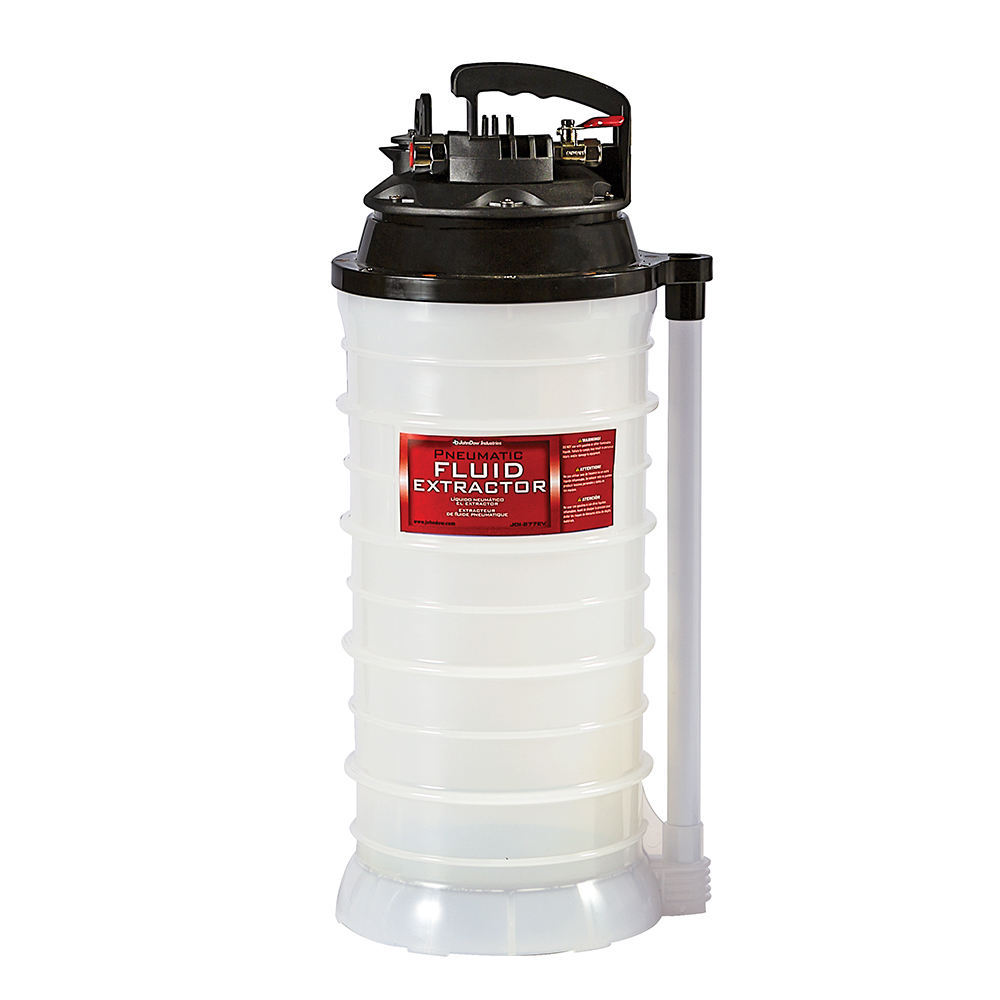
A pneumatic extractor – also called an air-operated or air-powered extractor – uses compressed air and a venturi vacuum system to generate suction automatically. Connect the unit to your shop’s air line, open the valve, and it creates a self-sustaining vacuum with no manual pumping required. Fluid flows until the tank is full or you close the valve.
For a service bay running multiple oil changes a day, the hands-free operation is not a luxury – it is a direct workflow advantage.
A technician who connects the pneumatic extractor, starts the draw, and walks to the next task is more productive than one standing at the bay pumping a handle. Across a full day of fluid service, that reclaimed time matters.
The JDI-277EV 2.7-Gallon Pneumatic Vacuum Fluid Extractor is JohnDow’s professional-grade option. It connects to your shop airline via a standard 1/4″ National Pipe Thread (NPT) quick coupler – the same fitting used on most shop air tools.The 2.7-gallon (10.5 liter) reservoir is the largest in the JohnDow extractor lineup, significantly more capacity than the manual units, which means fewer interruptions between jobs. It includes a built-in muffler for quieter operation, an air on/off valve, and an automatic overfill stop. At 6.2 lbs, it stays portable within the shop.
The same fluid types apply – engine oil, ATF, gear oil, coolant, brake fluid – and the same probe designs. For shops that want a spare probe set on hand, replacement tube sets are aslo available (No. CJ-006).
For a broader look at how fluid handling equipment fits into a well-run shop, JohnDow’s overview of the fluid handling lineup covers the full equipment picture in one place.
When Pneumatic Makes Sense
- Professional service bays with existing shop air infrastructure
- High-volume use: three or more fluid changes per day
- Multi-technician shops where one extractor rotates across several bays
- Operations where technician time is measured and efficiency is a priority
- Shops that need the larger tank capacity to reduce downtime between empties
Side-by-Side: Manual vs Pneumatic Fluid Extractor
|
Factor |
Manual (JDI-172EV / JDI-150DE) |
Pneumatic (JDI-277EV) |
|---|---|---|
|
Requires compressed air |
No |
Yes (1/4″ NPT) |
|
Reservoir capacity |
1.6-1.7 gal |
2.7 gal |
|
Extraction speed |
Moderate |
Fast |
|
Portability |
High – works anywhere |
Limited to air supply reach |
|
Physical effort |
Moderate (pumping) |
Minimal |
|
Discharge / refill function |
Yes (JDI-150DE only) |
No |
|
Best environment |
Home garage / mobile |
Professional service bay |
|
Max operating temp |
212 degrees F |
212 degrees F |
|
Weight |
6-6.6 lbs |
6.2 lbs |
Four Mistakes Buyers Make When Choosing
Buying pneumatic with no reliable shop air to back it up. The 1/4″ NPT fitting on the JDI-277EV is not a feature – it is a requirement. Without consistent compressed air from a compressor running at 90-120 PSI (pounds per square inch) with an adequate tank, the unit cannot generate vacuum. If your shop air setup is undersized or inconsistent, you will not get reliable extraction. Size your compressor before you commit to pneumatic.
Underestimating what a manual extractor can handle. Manual extractors do real, complete oil changes on passenger cars without issue. The pump builds vacuum quickly, and once fluid is flowing, extraction runs. Where manual units genuinely reach their limit is sustained, back-to-back commercial volume – not occasional home service. Do not write them off based on the fact that they require hand-pumping.
Missing the discharge function entirely. If you do a complete fluid change – drain old fluid and then refill – the JDI-150DE handles both steps. Most buyers do not know the discharge capability exists until they have already done a fluid change the inconvenient way.
Choosing capacity without checking your actual fluid volumes. The 1.7-gallon reservoir on the JDI-172EV handles most passenger car engine capacities comfortably. If you are servicing diesel trucks, larger SUVs, or marine engines with 8-10 quart oil capacities, the 2.7-gallon pneumatic tank gives you more headroom between empties.
For shop owners thinking about how equipment decisions fit into a bigger service operation strategy, how independent auto shops can build a competitive workflow is worth reading alongside this guide.
Which One Should You Buy?
You are a DIY mechanic working at home without a compressor. The JDI-172EV is your tool. Portable, capable, and proven across cars, motorcycles, ATVs, and small equipment. No infrastructure required.
You want to handle drain and refill in a single tool. Go with the JDI-150DE. The extract-and-discharge design means you complete the full fluid change without reaching for anything else.
You run a shop doing multiple fluid changes daily. The JDI-277EV is built for your operation. Hands-free pneumatic extraction, a larger tank, and a quieter muffler make it the right investment for high-volume professional use.
All three units are built from chemical-resistant heavy-duty polyethylene, ship with the same three-probe extraction set, and carry JohnDow’s quality standard behind them.
Conclusion
The manual vs pneumatic fluid extractor decision is not about which type is superior. It is about matching the tool to your workspace and your volume. Manual units give DIY mechanics the independence to work anywhere without equipment overhead. Pneumatic units give professional shops the throughput and hands-free operation to stay efficient across a full day of fluid service.
Pick the type that fits where you work. Pick the capacity that fits how often you use it.
Browse the full JohnDow fluid extractor lineup and find a distributor near you at johndow.com.
References
- Venturi Effect – Wikipedia: https://en.wikipedia.org/wiki/Venturi_effect
- JohnDow Industries Product Documentation – JDI-172EV User’s Manual: https://f.hubspotusercontent10.net/hubfs/5524718/By%20Product/Fluid%20Handling/JDI-172EV%20Fluid%20Extractor/JDI-172EV%20Revised%20Manual%203%2015%2021.pdf
- JohnDow Industries Product Documentation – JDI-277EV User’s Manual: https://f.hubspotusercontent10.net/hubfs/5524718/By%20Product/Fluid%20Handling/JDI-277EV%20Fluid%20Extractor/JDI-277EV%20Revised%20Manual%203%2012%2021.pdf
- JohnDow Industries Product Documentation – JDI-150DE User’s Manual: https://info.johndow.com/hubfs/JDI-150DE%20Manual%202%2027%2024-1.pdf
FAQ
What is the difference between a manual and pneumatic fluid extractor?
A manual fluid extractor creates vacuum through hand-pump action and requires no additional equipment – making it ideal for home garage and DIY use. A pneumatic fluid extractor connects to a shop air compressor and generates vacuum automatically, making it the right choice for professional service bays handling high volumes of fluid changes daily.
Do I need an air compressor to use a fluid extractor?
Only if you are using a pneumatic model. The JDI-277EV requires a compressed air source – typically a compressor delivering 90-120 PSI – to operate. JohnDow’s manual extractors, the JDI-172EV and JDI-150DE, require no air compressor and work anywhere.
Can a fluid extractor replace a drain plug for oil changes?
A fluid extractor working through a dipstick tube evacuates the bulk of accessible oil in the crankcase. It is widely used in professional shops for routine maintenance. Some residual fluid may remain in oil passages and areas the probe cannot reach. For a fully complete flush in a high-precision application, a drain plug extraction is the most thorough method.
What PSI does the JDI-277EV pneumatic extractor require?
The JDI-277EV connects via a standard 1/4″ NPT quick coupler. Most shop compressors running at 90-120 PSI will deliver reliable venturi vacuum operation. Ensure your airline diameter and compressor tank size are adequate before purchasing the pneumatic unit.
Can fluid extractors handle transmission fluid and brake fluid, not just engine oil?
Yes. All three JohnDow fluid extractors – the JDI-172EV, JDI-150DE, and JDI-277EV – handle engine oil, automatic transmission fluid (ATF), gear oil, coolant, and brake fluid. The included probe set covers the tube diameters needed for most passenger vehicle service points.