

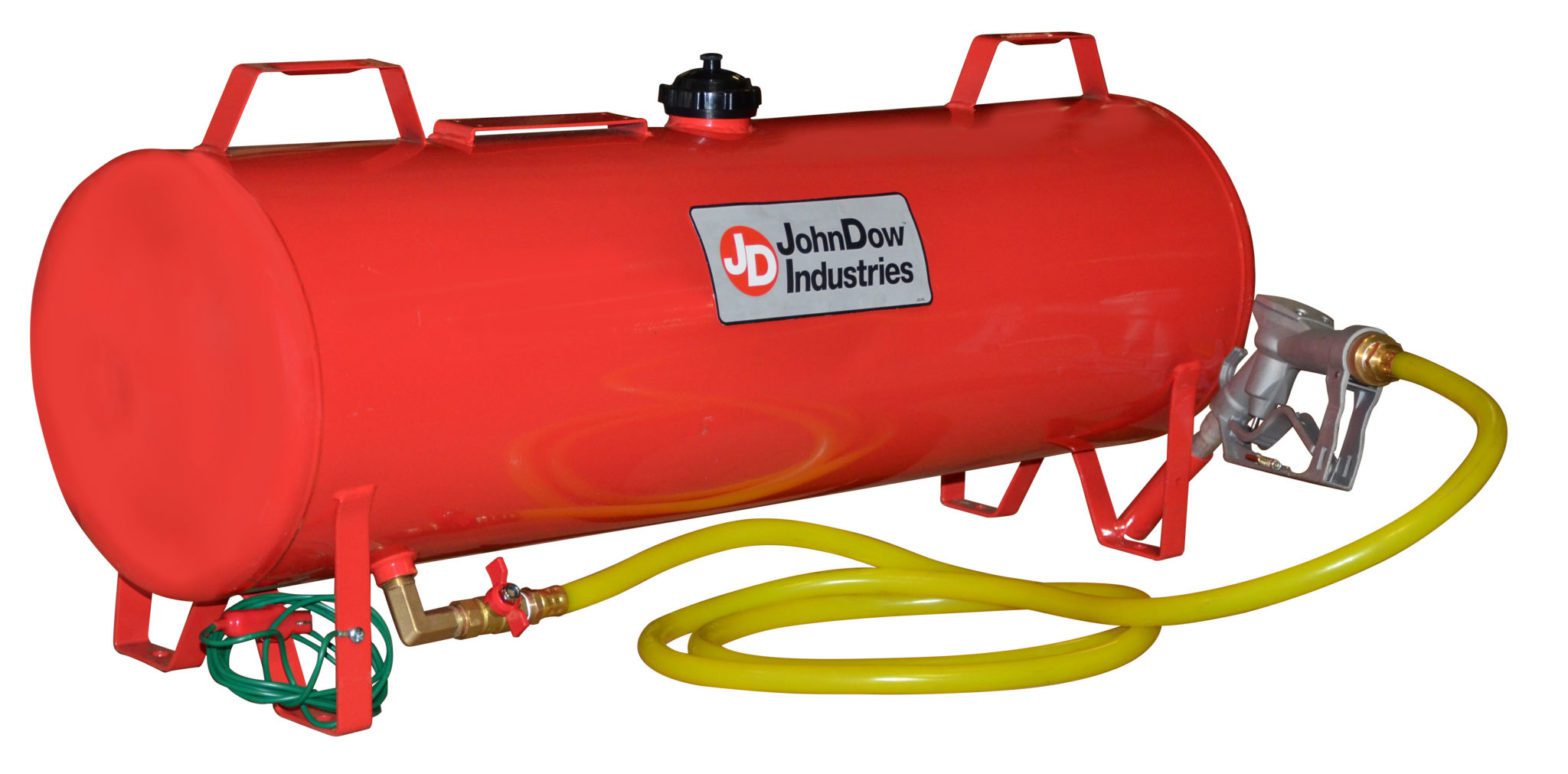
A fire marshal walks into a busy commercial garage outside Columbus, Ohio, and shuts down three service bays. Not because of a mechanical failure, but because the shop was using an uncertified plastic fuel caddy to top off customer vehicles. One non-compliant container. Three bays. A full day of lost revenue.
This exact story is not real but this is more common than most shop owners want to admit. Occupational Safety and Health AdministrationOSHA (OSHA) mandates that quantities of flammable liquids exceeding 25 gallons require fire-resistant storage. A standard red plastic gas can certainly does not meet OSHA’s 29 CFR 1926.152(a)(1) jobsite requirements. If you are running a commercial garage, a fleet shop, or a multi-bay service facility, the container you choose is not just a convenience; it is a liability.
This guide breaks down the best UL-Listed fuel transfer tanks available for commercial use, explains what the UL listing actually means in practice, and helps you match the right product to your shop’s specific fueling needs.
What “UL Listed” Actually Means for Fuel Tanks
The UL listing granted by Underwriters Laboratories (UL), an independent safety certification organization, is not a sticker a manufacturer applies to its own product. It means the tank has been independently tested and verified to meet published safety standards for flammable liquid containers.
A UL Listed fuel tank has passed testing for leakage, rupture, stability, abuse, and endurance under controlled conditions.
This matters in a commercial setting for three reasons:
First, OSHA’s General Industry Standard (29 CFR 1910.144) specifically references containers listed or approved by a nationally recognized testing laboratory.
Second, your insurance carrier may deny a claim related to a fuel-related fire if non-certified equipment was in use.
Third, there is a meaningful difference between “UL Listed” and “UL Classified” – only the Listed designation signals full independent approval. Read the label closely before purchasing.
One thing trips up shop managers regularly: assuming any steel tank qualifies. Steel construction is necessary, but not enough. The pump, the hose assembly, the vent cap, and the grounding wire must all meet specification as part of the listed assembly.
The JohnDow Fuel Transfer Tank Lineup: Matched to Real Shop Needs
JohnDow Industries has built its fuel handling line specifically for professional automotive service environments. Every product below is engineered with UL Listing, OSHA compliance, and daily commercial use in mind.
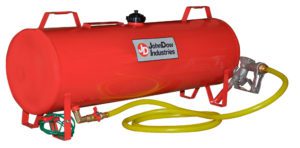
The 25-Gallon UL-Listed Steel Gas Caddy (FC-25GC)

If your shop services gasoline-powered vehicles and occasionally needs to drain and/or work on fuel tanks, the FC-25GC is the benchmark product in this category.
The 25-Gallon UL-Listed Steel Gas Caddy is built from 14-gauge steel and carries a full UL-Listed designation, including a UL-Listed cast iron rotary pump with carbon vanes and Viton seals delivering one gallon per 12 pump handle revolutions. It handles gasoline, kerosene, and transmission fluid making it genuinely useful across a broader range of service bay tasks than most shops expect.
What sets it apart from cheaper alternatives is the safety architecture built into the assembly. The 8-foot PVC suction/discharge hose includes an internal steel grounding wire. A dedicated grounding wire and clamp mount on the rear handle bracket. The combination vent and fill cap is fire-screened. The front feet feature aluminum skid plates to prevent spark generation on concrete floors. These features are what UL-listings require for compliance.
The 8-inch heavy-duty steel wheels carry a loaded tank weight of over 300 pounds without flexing.
Best for: Multi-bay automotive shops who regularly drain or transfer gasoline as part of diagnostic or repair work.
The 25-Gallon UL-Listed Steel Diesel Caddy (FC-25DC)
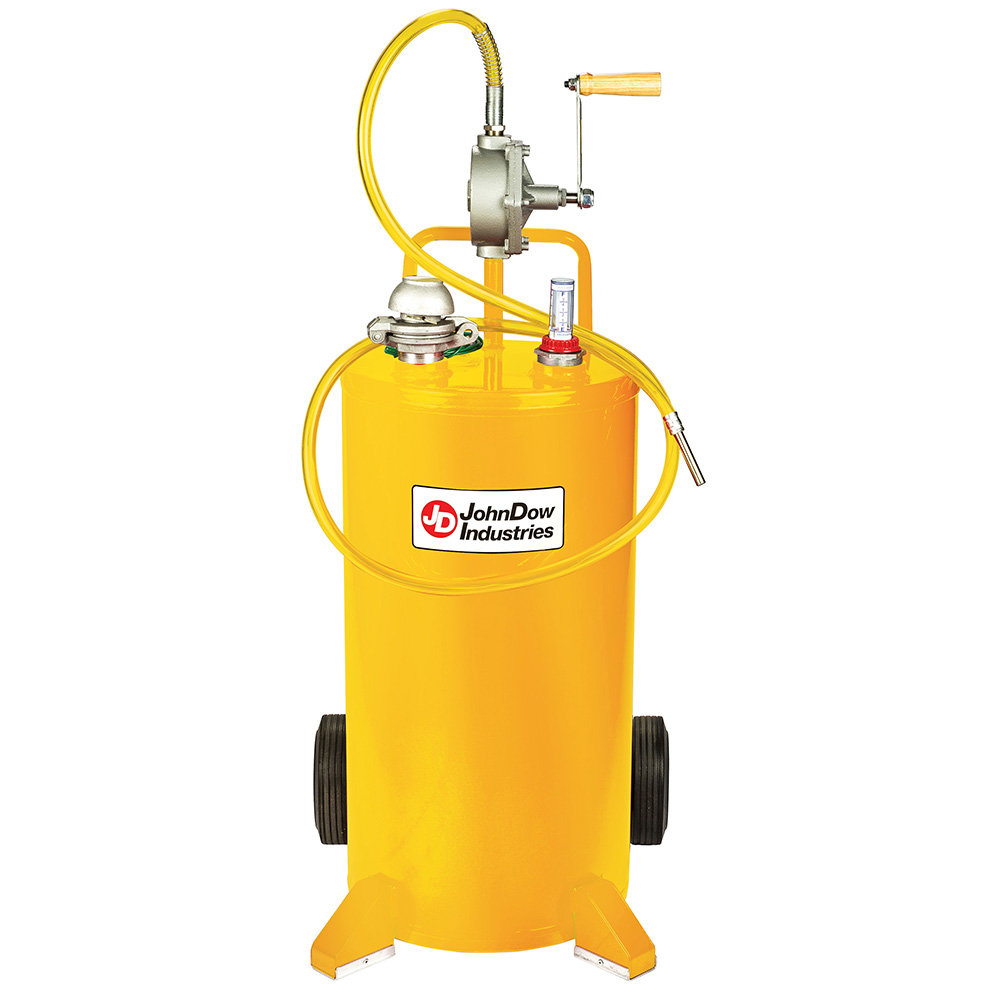
The diesel counterpart to the FC-25GC shares the same UL-Listed steel construction and safety features but is configured specifically for diesel fuel. If your shop services commercial trucks, fleet vehicles, or diesel-powered equipment, this is the appropriate choice.
Having both a gas and diesel caddy in your facility gives technicians the right tool for each fuel type without improvising; which is exactly how compliance violations happen. Fuel contamination from the wrong caddy is a real service issue, not just a safety footnote.
The 30-Gallon PRO30 Series
For higher-volume operations, JohnDow’s PRO30 series steps up to a 30-gallon UL-Listed steel tank available with either a manual pump or an air-operated pump.
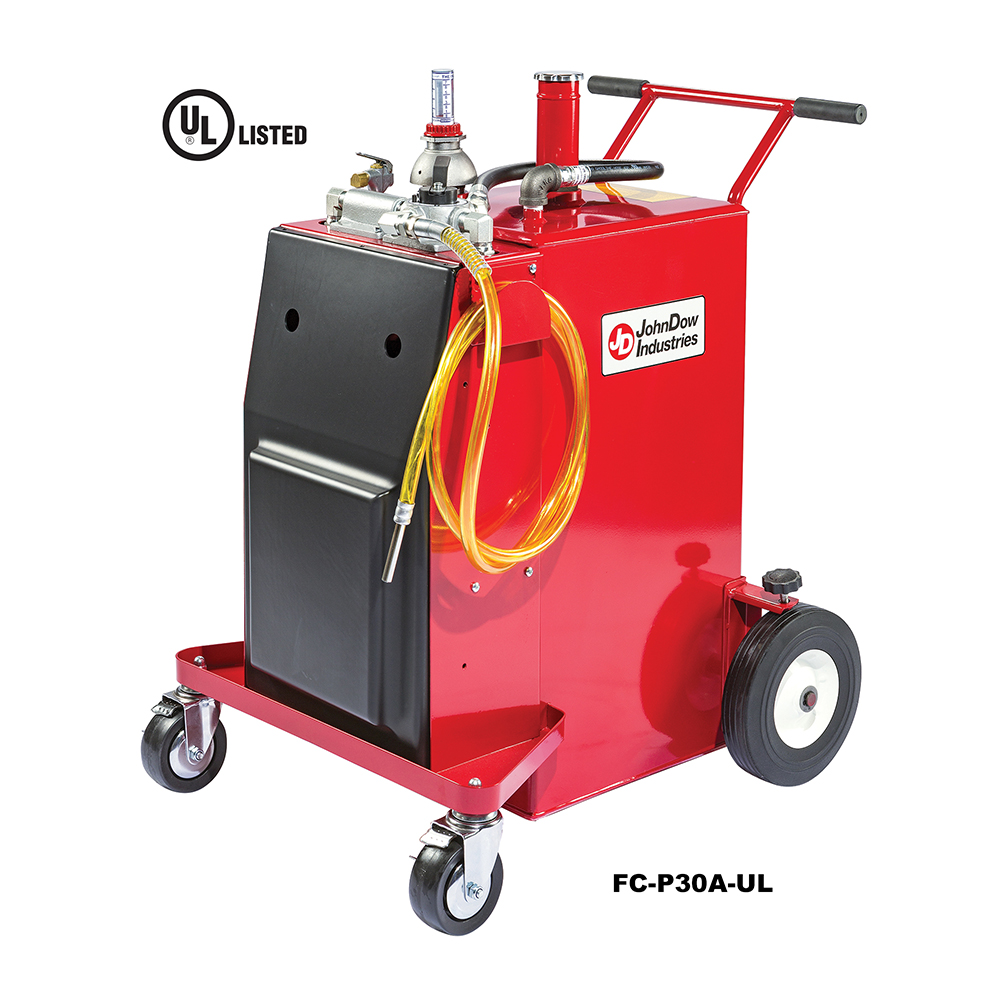
The air-operated version is worth serious consideration for shops who run a compressed air system. Transfer rates increase significantly compared to manual operation, with lower technician fatigue on high-volume days. The PRO30 line uses the same 14-gauge steel construction and full UL-Listed certification as the 25-gallon caddies.
The PRO30 with an air-operated pump is the right call for shops doing 10 or more fuel transfer operations per day.
The 40-Gallon, 58-Gallon ND 106-Gallon Carrytanks UN/DOT Approved
Once you move beyond the service bay into fleet refueling, outdoor equipment, or pick-up-and-go portable refueling, the Carrytank series handles the load.
The 58-Gallon Diesel Carrytank (JDI-AFT58) and its 106-gallon sibling (JDI-AFT106) are built from rugged linear polyethylene and powered by a 12-volt transfer pump, which can connect to your truck’s battery, and delivers fuel at 10 gallons per minute. Both units include integrated forklift pockets for moving a full tank, molded recesses for ratchet strap tie-down during truck transport, and a lockable protective cover.
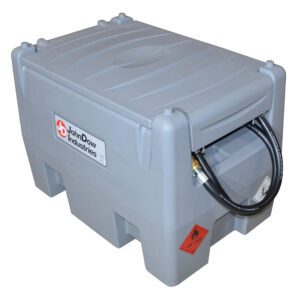
The 40-gallon low-profile variants, available for gasoline, diesel, and DEF (Diesel Exhaust Fluid), are ideal for a tight pickup bed or trailer clearance. The low-profile design means you can carry fuel in a standard pickup without exceeding bed rail height.
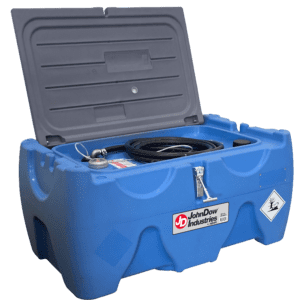
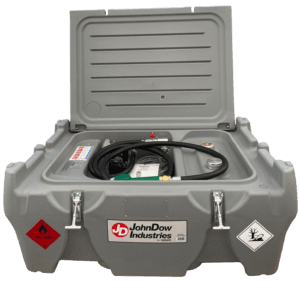
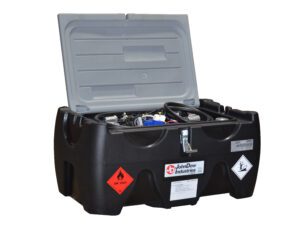
For operations running diesel equipment and requires DEF, the 106-gallon Carrytank (JDI-AFT106) includes an optional 10-gallon DEF dispensing tank that fits in the tool storage compartment and runs off the same 12-volt power source, eliminating the need for a separate DEF unit.
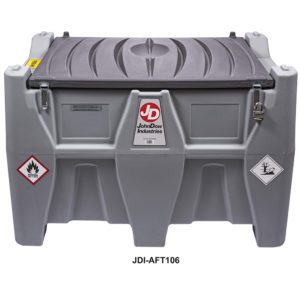
Important note: Match your Carrytank to your fuel type (diesel vs gasoline) at time of purchase.
The 15-Gallon Portable Fuel Station (JDI-FST15) – Compact, UN/DOT Approved
Not every fueling task happens at a service bay. Golf course maintenance crews, landscaping operations, and small engine service shops need a compact, certified fuel transfer system that moves easily.
The JDI-FST15 is a United Nations (UN) and US Department of Transportation (DOT) approved 15-gallon welded steel tank with a gravity-fed dispensing system, 10-foot dispensing hose, built-in shut-off valve, squeeze handle dispenser, and a ground wire for static discharge safety. It has been tested for leakage, rupture, stability, abuse, and endurance, and can bolt directly to a trailer for transport.
At 29 pounds empty, it is genuinely portable. The gravity-fed design eliminates the need for a pump, but it also comes with a hand pump for situations where gravity is not in your favor.
How to Choose the Right Tank for Your Operation
The wrong tank is a safety risk and operational inefficiency.
Here is a quick decision framework:
|
Your Primary Need |
Recommended Product |
|---|---|
|
Gasoline transfer in a service bay | |
|
Diesel transfer in a service bay | |
|
High-volume daily fuel transfer (gas or diesel) | |
|
Fleet/outdoor portable diesel refueling | |
|
Diesel + DEF combined operation | |
|
Low-clearance vehicle or trailer carry |
40-Gal Low-Profile Carrytank |
|
Small engine and outdoor equipment service |
3 Mistakes Commercial Garages Make With Fuel Handling Equipment
Mistake 1: Confusing “steel” with “certified.” A tank can be steel and still fail UL testing. The pump, the vent cap, and the hose assembly must all be part of the listed configuration. When you buy a UL-Listed JohnDow fuel caddy, you are buying the complete certified system, not just a steel container.
Mistake 2: Using a gasoline caddy for diesel, or vice versa. Fuel contamination is a major service error. Cross-contaminated fuel can damage fuel injectors and diesel particulate filters. Use the correct model for each fuel type from day one.
Mistake 3: Skipping the grounding step. Static charge builds when fuel flows into a metal container, and if you don’t ground the tank, a spark near the open fill point can ignite fuel vapor. Every JohnDow UL-Listed caddy includes a ground wire and clamp for this reason. Use it – every transfer, without exception.
The Bottom Line
Fuel handling is not a corner you cut. A non-certified container is a fire risk, safety risk, a compliance violation, and an insurance liability rolled into one. The UL-Listed fuel transfer tank line from JohnDow Industries gives you a full range of certified options from compact 15-gallon portable stations to 106-gallon field-deployable Carrytanks, all built specifically for professional service environments.
Browse JohnDow’s complete fuel handling lineup and find the right certified tank for your operation or call 1-866-382-5057 to speak with a product specialist.
References
FAQ
- Does a UL Listed fuel transfer tank satisfy OSHA requirements in a commercial garage?
UL Listed status means the tank has been certified by a nationally recognized testing laboratory, which is the standard OSHA references for flammable liquids handling. However, OSHA requirements also govern storage location, ventilation, quantity limits, and fire cabinet ratings. Tank certification is one component of a fully compliant setup. - Can I use a diesel Carrytank inside my shop building?
OSHA regulations permit dispensing combustible liquids inside facilities under specific conditions, including automatic-closing nozzles and identified emergency shut-off devices. Check your local fire code and consult your fire marshal before positioning any portable fuel tank inside an enclosed service bay. - What is the difference between a fuel caddy and a Carrytank?
A fuel caddy is designed for service bay use – draining fuel from vehicles and short transfers within a shop. A Carrytank is designed for portable field refueling – mounting in a truck bed or on a trailer to fuel equipment at remote locations. Capacity, pump mechanisms, and portability features differ significantly. - What makes a fuel transfer tank OSHA compliant for commercial garages?
OSHA’s General Industry Standard (29 CFR 1910.144) requires that containers used for flammable liquids be listed or approved by a nationally recognized testing laboratory such as Underwriters Laboratories (UL). For quantities exceeding 25 gallons, fire-resistant storage is mandatory. The entire assembly — including the pump, vent cap, hose, and grounding wire — must be part of the certified configuration, not just the tank body itself. - Can I use the same fuel caddy for both gasoline and diesel?
No. Using a gasoline caddy for diesel, or vice versa, risks fuel contamination which damages fuel injectors and diesel particulate filters. Commercial garages should maintain a dedicated caddy for each fuel type and label them clearly to prevent cross-contamination during busy service bay operations.